








GLAUCOMA TREATMENT
- Home
- GLAUCOMA TREATMENT
Types of glaucoma (kala motia)
Glaucoma may be classified as open-angle or closed-angle or mixed/ secondary type of glaucoma.
Primary Open glaucoma
It is widely known as open-angle glaucoma and is the most common form of glaucoma. It is caused by increased eye pressure which slowly causes damage to the optic nerve and consequent vision loss. Classically the filtration angle (an area between the cornea and iris through which the aqueous humour filters out of the eye) is open. The patient may have high pressure or a vague feeling of heaviness. Associated features may include headache or decrease in vision. Often it is asymptomatic and the patient may not feel anything.
Open-angle glaucoma treatment
- When you visit the eye doctor at Centre for Sight for these complaints the medical staff will take your history and record your vision and eye pressure. The doctor will then examine you and recommend tests if needed. Your eye pressure will be recorded by Applanation Tonometry and the optic disc (nerve of the eye) will be examined for any variation in size as compared to normal. A visual field test will be advised to evaluate the function of the optic nerve. An OCT may be advised to see the thickness of the optic nerve fibres.
-
What Is Glaucoma?
Recognizing the Symptoms
Glaucoma is the name given to a group of conditions in which the optic nerve sustains damage where it leaves the eye.
In many cases, this damage is associated with a rise in pressure within the eye. As the pressure builds, it compresses the fragile blood vessels supplying the optic nerve, which sends messages to the brain. If left untreated, this can lead to irreversible damage to the optic nerve.
What Causes Glaucoma?
A clear liquid called aqueous humor flows through the eye nourishing the lens, iris, and cornea. When the delicate mesh that forms the drainage system becomes restricted or completely blocked, the liquid continues to flow into the eye and pressure builds up.
It is this build-up of pressure which causes Glaucoma
In a normal eye there is a constant flow of fluid (aqueous humor)
from the inner chamber to the outer chamber.
This fluid is free to drain out of the eye, through the drainage channels
(Canal of Schlemm) at the outer edge of the iris, and return to the veins.
With Glaucoma, the drainage channels are restricted or blocked.
Recognizing the Symptoms
The most common form of Glaucoma, Open Angle, starts gradually and gives no warning symptoms, until a very late stage, when much irreversible damage has been done to the field of vision.
Without treatment it can progress to complete blindness.
A much less common form of Glaucoma, Acute Closed Angle, starts with severe pain in the eye, headache, blurring of vision, halos around sources of light, and darkening at the outer edges of your sight (Peripheral Vision).
This needs immediate treatment.
Where pressure is normal within the eye, vision is clear right to the edges of the field of view.
Increased pressure may lead to darkening at the edges of the field of view (tunnel vision).
How is glaucoma treated?
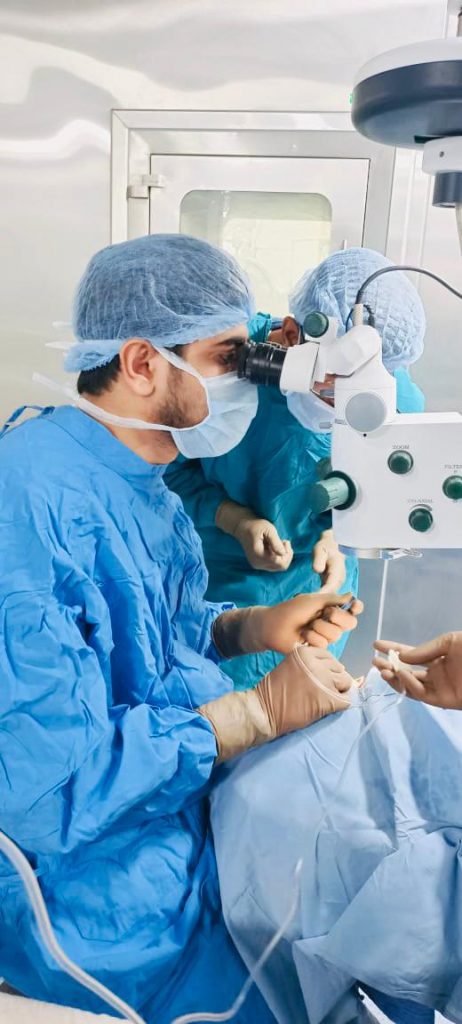
As a rule, damage caused by glaucoma cannot be reversed. Eyedrops, laser surgery, and surgery in the operating room are used to help prevent further damage, in some cases, oral medications may also be prescribed. With any type of glaucoma, periodic examinations are very important to prevent vision loss. Because glaucoma can progress without your knowledge, adjustments to your treatment may be necessary from time to time.
Who is at risk for glaucoma?
Your ophthalmologist considers many kinds of information to determine your risk for developing the disease.The most important risk factors include:
age;
elevated eye pressure;
family history of glaucoma;
African or Spanish ancestry;
farsightedness or nearsightedness;
past eye injuries;
thinner central corneal thickness;
systemic health problems, including diabetes, migraine headaches, and poor circulation. Your ophthalmologist will weigh all of these factors before deciding whether you need treatment for glaucoma, or whether you should be monitored closely as a glaucoma suspect. This means your risk of developing glaucoma is higher than normal, and you need to have regular examinations to detect the early signs of damage to the optic nerve.